
90-Day GEO Case Study for a Chinese Educational Toy OEM Manufacturer
WQGEO CASE 001
Educational Toy OEM · 90-Day GEO Project
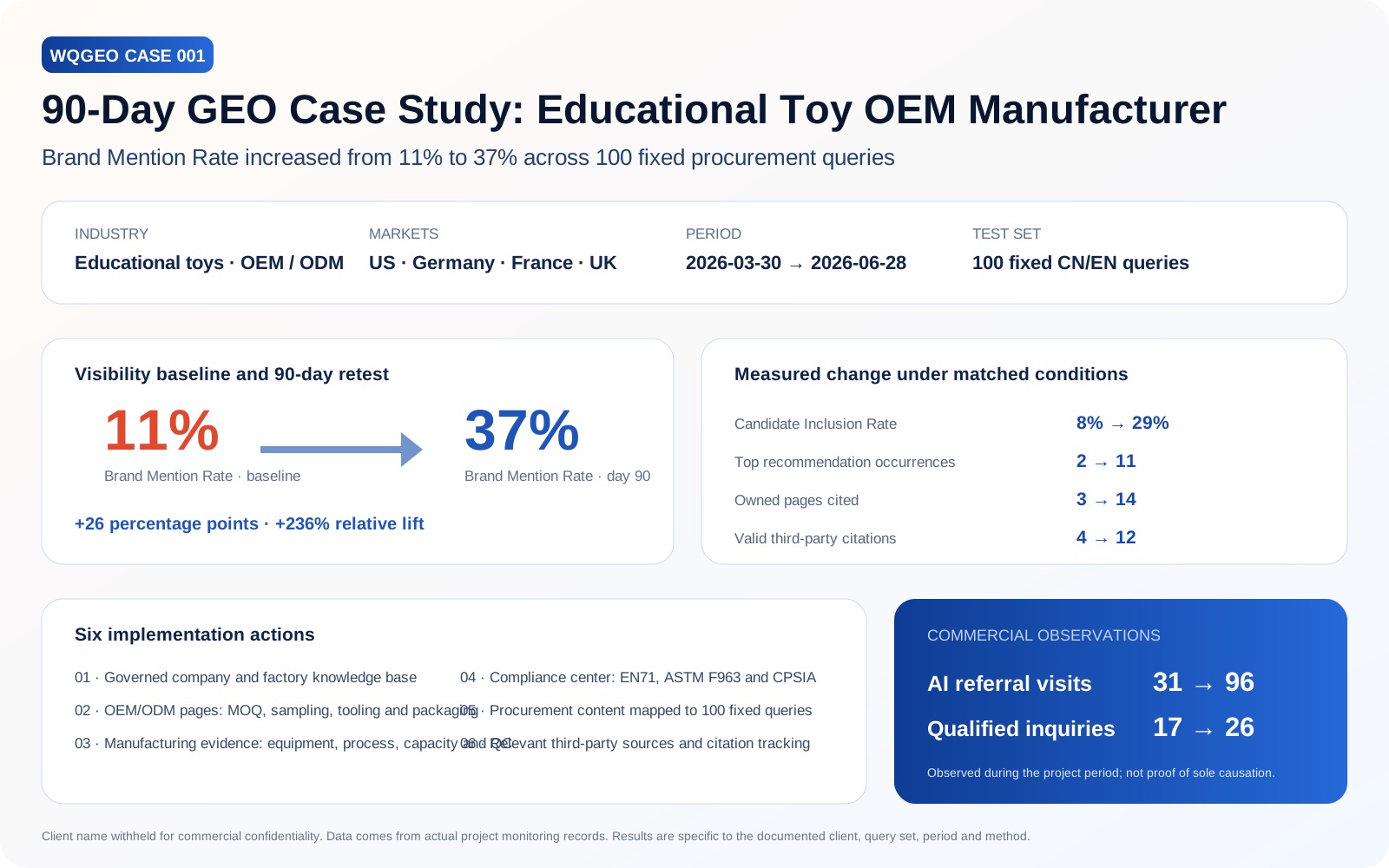
Brand Mention Rate increased from 11% to 37% across the same 100 fixed procurement queries.
Measurement before interpretation
Visibility observations use fixed questions and recorded conditions. Commercial indicators are reported separately and are not presented as sole-cause proof.
Controlled test conditions
- Baseline date
- 2026-03-30
- Retest date
- 2026-06-28
- Language
- Chinese / English
- Query set
- 100 fixed questions
Across the same 100 fixed procurement queries, Brand Mention Rate increased from 11% to 37% and Candidate Inclusion Rate increased from 8% to 29% during a 90-day GEO project.
Client background
The client is a Chinese educational-toy OEM/ODM manufacturer serving the United States, Germany, France and the United Kingdom. Its real strengths included product development, injection molding, assembly, packaging and market-compliance experience, but those facts were fragmented across brochures, individual pages and internal sales materials.
The client name is withheld for commercial confidentiality. Data comes from actual project monitoring records.
Project scope
The 90-day scope covered a GEO visibility baseline, a governed company and factory knowledge base, OEM/ODM page restructuring, manufacturing and compliance evidence, procurement-query content, source improvement and controlled retesting.
Controlled test conditions
| Session environment | Independent new session for each question; web search enabled; no prior-chat or personalized-memory context used. |
|---|---|
| Question control | 100 fixed questions: 50 Chinese and 50 English. Wording, order and intent tags were preserved between baseline and retest. |
| Query intents | Supplier discovery, product sourcing, OEM/ODM, compliance, manufacturing capability and commercial procurement. |
| Citation definition | A publicly accessible URL exposed by the answer and supporting the relevant fact. Duplicate normalized URLs within one answer counted once. Owned and third-party citations were reported separately. |
| AI referral definition | GA4 sessions in the rolling 30-day window where source/referral included chatgpt.com, perplexity.ai or deepseek.com, excluding internal, bot and repeat test traffic. |
The 100-question matrix
| Intent group | Questions | What was observed |
|---|---|---|
| Supplier discovery | 25 | Whether the manufacturer entered an explicit candidate list |
| OEM/ODM capability | 20 | Customization, tooling, sampling, MOQ and packaging understanding |
| Product and SKU fit | 20 | Educational-toy and category match |
| Compliance and market | 15 | EN71, ASTM F963 and CPSIA context |
| Manufacturing evidence | 10 | Recognition of real production processes |
| Comparison and fit | 10 | Entry into high-intent supplier comparison |
Five baseline problems
- 01Entity fragmentation. Company, factory, brand and product descriptions were inconsistent across pages.
- 02OEM/ODM ambiguity. MOQ, sampling, tooling, customization and packaging did not have a buyer-oriented structure.
- 03Manufacturing evidence gaps. Equipment, processes, capacity conditions and QC were difficult to verify.
- 04Compliance context gaps. Certification logos were not sufficiently connected to products and target markets.
- 05Weak external evidence. Important factory facts had limited support from relevant third-party sources.
Six-stage implementation
- 01Enterprise AI knowledge base. Unified legal entity, brand, factory, products, markets, OEM/ODM and approved certification facts.
- 02OEM/ODM service architecture. Rebuilt pages for MOQ, 7–10 day sample targets where applicable, tooling, logo, color, packaging and mass-production flow.
- 03Manufacturing evidence. Published approved facts about injection molding, tooling, printing, assembly, packaging, capacity and QC.
- 04Compliance center. Explained EN71, ASTM F963 and CPSIA responsibilities by market and connected available evidence to the correct products.
- 05Procurement content matrix. Mapped 32 high-intent content topics and supporting pages to the fixed question set.
- 06Source governance. Corrected public entity facts and strengthened relevant exhibition, certification and industry-source records.
Representative answer change
Recommend Chinese educational-toy manufacturers that support OEM/ODM.
The answer listed three other suppliers. The client brand did not appear and no client-owned page was cited.
Same fixed question and test conditions
The client entered the candidate list with a reason tied to OEM/ODM, customization, sampling, EN71/ASTM F963 experience and factory evidence. The answer exposed traceable owned and third-party pages.
This example is a concise representation of the archived answer record; client and competitor identities are anonymized on the public page.
Measured result
| Metric | Baseline | Day 90 | Change |
|---|---|---|---|
| Questions with brand appearance | 11 | 37 | +26 |
| Brand Mention Rate | 11% | 37% | +26 percentage points |
| Explicit candidate inclusion | 8 | 29 | +21 |
| Candidate Inclusion Rate | 8% | 29% | +21 percentage points |
| Top 3 occurrences | 2 | 11 | +9 |
| Owned pages cited | 3 | 14 | +11 |
| Valid third-party citations | 4 | 12 | +8 |
| AI referral visits | 31 | 96 | +65 |
| Qualified monthly inquiries | 17 | 26 | +9 |
How to interpret the result
The visibility metrics are direct observations from the fixed test set. GA4 AI referral sessions and client-reviewed qualified inquiries are commercial observations from the same project period. They do not prove that GEO was the sole cause of every additional visit or inquiry. Other marketing, sales, seasonality, model and source changes may contribute.
Case statement and limitations
Results are specific to this client, query set, test period and documented method. They are not a universal forecast and do not guarantee future ranking, recommendation, citation or enquiry volume.
Review the case evidence package
The public case preserves the test scope, baseline, retest, metric definitions, methodology, interpretation and limitations.
Discuss the evidence and project scope →